Method for controlling the simultaneous confidence level for an entire set of confidence intervals. It is important to consider the simultaneous confidence level when examining multiple confidence intervals because your chances that at least one of the confidence intervals does not contain the population parameter is greater for a set of intervals than for any single interval. To counter this higher error rate, Bonferroni's method adjusts the confidence level for each individual interval so that the resulting simultaneous confidence level is equal to the value you specify.
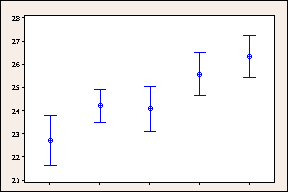
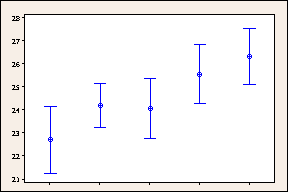
For example, you want to examine the confidence intervals for delivery time in days from five shipping centers. You generate the two sets of five confidence intervals below using the same data.
|
Unadjusted 95% Confidence Intervals for Delivery Times by Shipping Center |
Bonferroni 95% Confidence Intervals for Delivery Times by Shipping Center (99% Individual Confidence Intervals) |
|
|
|
|
These graphs compare regular 95% confidence intervals (left) to the Bonferroni 95% confidence intervals (right). The wider Bonferroni confidence intervals provide less precise estimates of the population parameter but limits the probability that one or more of the confidence intervals does not contain the parameter to a maximum of 5%. In comparison, the family error rate associated with the five regular 95% confidence intervals is 25 percent. This conservative method ensures that the overall confidence coefficient is at least 1- a. To obtain an overall confidence coefficient of 1- a for the joint interval estimates, Minitab constructs each interval with confidence coefficient (1- a / g), where g is the number of intervals. In the Bonferroni intervals above, these are actually 99% confidence intervals (1.00 - 0.05 / 5 = 0.99) that are used to achieve the 95% simultaneous confidence level. |
|
Free online chart generators for statistical analysis:
Useful tools: